


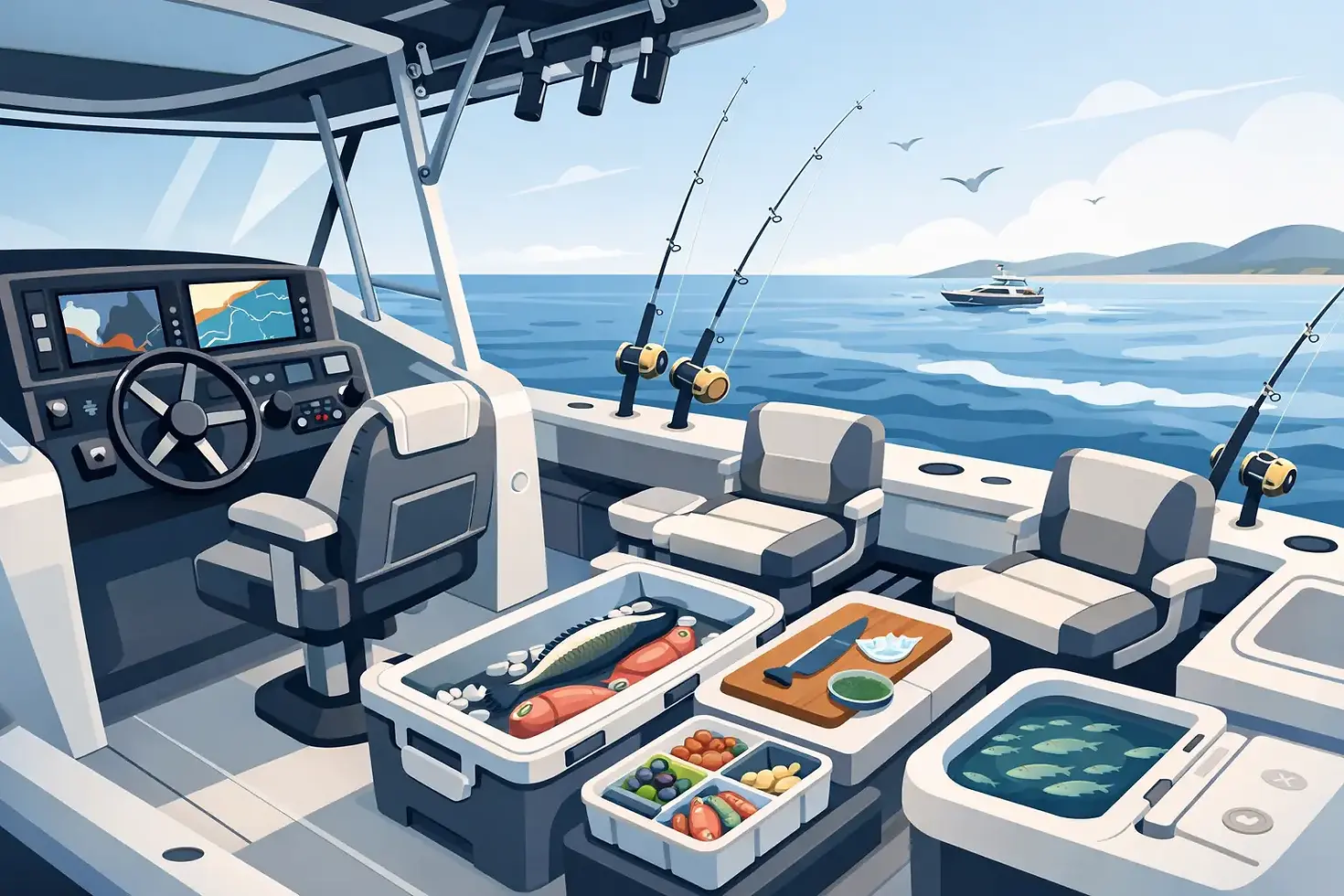
Cockpit Workspace Planning for Serious Fishing
A cockpit can go from organized to dangerous in one hot bite. A knife slides under a loose rag, bait juice runs toward a hatch, and someone has to step around a cooler to reach the gaff. Good cockpit workspace planning prevents that kind of mess before the first bait is cut. It gives every working tool a position, keeps traffic lanes open, and turns the back of the boat into a Professional Grade fishing station.
Start With the Work, Not the Empty Space
The wrong way to plan a cockpit is to find an open spot and bolt down a board. Start by looking at how the boat is actually used from the marina to the run home. Where do anglers stand during a hookup? Which hatch needs to open? Where does the mate need to move when clearing lines? Where do fish come aboard, and where are they cleaned?
A bait-cutting station, a fish-cleaning surface, and a serving or rigging area do not always belong in the same location. On a smaller center console, one removable rail-mounted board may need to do all three jobs. On a larger sport-fisher or yacht, separate zones can make more sense. The right answer depends on cockpit size, crew size, rail layout, and how hard the boat fishes.
Before choosing equipment, walk the cockpit with a tape measure and mark the working areas. Measure the clear space behind fighting chairs, transom doors, livewell lids, engine hatches, and storage compartments. A board that looks properly placed at the dock may become a knee-buster when the crew is moving quickly offshore.
Build Clear Zones Into Cockpit Workspace Planning
A working cockpit needs defined zones, even if the deck is compact. The goal is not to fill every rail and flat surface with accessories. It is to keep tools close to the job without blocking the crew.
The bait and rigging zone
Put bait preparation where it can be reached without crossing the main fighting area. For many boats, that means a side rail or transom-adjacent position that stays clear of the centerline. The station should hold a cutting board, knife, bait scissors, hooks, leader material, and a small waste container or bag within easy reach.
A board with an integrated knife sharpener can reduce loose gear and eliminate the need to hunt for a sharpener when ballyhoo needs to be prepped fast. If your crew regularly rigs multiple bait types, a larger 30-inch work surface provides room for bait trays and tools. A 24-inch board can be the better choice when rail length and walkway clearance are limited.
The fish-handling zone
Fish handling needs a tougher, cleaner setup than basic bait prep. Place the fillet board where the catch can be moved from the transom or fish box without dragging it through the cockpit. It should also be close enough to a washdown hose for quick cleanup.
Keep this station outside the primary path to rod holders and the helm access route. On boats that fish with several people aboard, a removable or pole-holder-mounted board can be a smart solution. It creates a solid work surface when needed and clears the cockpit after the fish are boxed or the day is done.
The traffic zone
The center of the cockpit is usually the crew's highway. Protect it. Anglers need room to move around a fighting chair, chase a fish from one side to the other, handle a gaff, and access the transom. Nothing sharp, slick, or permanent should force people into a narrow path during a fight.
This is where many installations fail. A large board may offer more cutting area, but not if it projects into a route the crew uses constantly. Measure the board's full depth after mounting, not just its width. Account for elbows, knees, tackle bags, and the boat's motion.
Choose Materials That Belong Offshore
A cockpit work surface takes more abuse than a kitchen cutting board ever will. It sees UV exposure, salt spray, fish scales, blood, bait oils, hooks, knife edges, and impact from coolers and tackle. Household plastic boards and plated hardware may look acceptable at first, but they are not built for the brutal Offshore Elements.
Marine-grade HDPE, including UV-protected King ColorCore HDPE, is made for this job. It resists moisture, does not rot, is easy to wash down, and holds up under regular exposure to sun and salt. It also provides a clean, solid cutting surface without the maintenance demands of wood.
Hardware matters just as much as the board itself. U.S. 316 stainless steel offers serious corrosion resistance in saltwater conditions. Lower-grade stainless can stain, pit, or seize over time, especially where hardware remains wet or salt accumulates in rail connections. A board is only as dependable as the mount holding it when the boat is running or the sea gets rough.
White is a practical choice for sanitation because residue is easy to see and clean. Custom colors, boat names, logos, and lettering can add a finished look, but function comes first. If the board will be used for bait and food preparation, establish a cleaning routine and keep the intended use clear to everyone aboard.
Make Mounting Decisions Around Access and Load
The mounting method should match the job. Rail mounts are useful when you want a dedicated work surface without drilling into the boat. They can be positioned along a compatible rail and removed or relocated as the fishing plan changes. Pole-holder mounts are another strong option for boats with existing rod holder locations, particularly when rail space is limited.
Permanent mounts can work well on larger boats with a dedicated rigging or fish-prep area. The trade-off is flexibility. Once a permanent board is installed, it occupies that footprint whether the boat is fishing, cruising, entertaining, or tied up at the dock.
Check the diameter, shape, and condition of the rail before ordering a rail-mounted accessory. Also consider what is beneath and behind the mounting location. Do not assume a rail is strong enough for a loaded board without verifying its attachment points. A cutting board may only weigh a few pounds, but fish, bait, tools, and a crew member leaning on it can create a real load.
For a custom build, provide the rail measurement, photos of the mounting area, desired board dimensions, and any clearance concerns. This is where made-to-order fabrication earns its keep. Offshore Products can build around nonstandard board shapes, rail configurations, boat names, and specific work requirements rather than asking the boat owner to compromise around generic equipment.
Keep the Surface Clean and the Deck Clear
A good workstation reduces clutter, but it does not eliminate the need for operating discipline. Keep only the tools needed for the current task on the board. Extra knives, open hook packs, leader spools, drink cans, and loose electronics do not belong beside a cutting surface.
Use cup holders where they keep drinks off the work area and out of the path of feet. Store measuring tools, lobster gauges, and fish-handling accessories where they can be reached without laying them across the board. If bait scraps are building up, clear them before they become a slipping hazard or wash into a place you do not want them.
After every trip, wash the board, mounts, and hardware with fresh water. Pay attention to the underside of the board, rail contact points, fasteners, and crevices around integrated accessories. Periodically inspect hardware for looseness and look for stress around mount points. Saltwater finds neglected equipment quickly.
Plan for the Boat You Run Most Often
There is no universal cockpit layout. A weekend bay boat, a center console running offshore canyons, and a charter sport-fisher have different space, crew, and catch-handling demands. The best cockpit workspace planning is specific to the boat's normal use, not a catalog photo or somebody else's deck layout.
Set up the cockpit so a crew member can cut bait, sharpen a knife, grab a drink, access a hatch, and move toward a hooked fish without creating a pileup. If a work surface cannot do that job cleanly, change its location, size, or mount before it becomes permanent. The right board in the right position will earn its space every time the boat leaves the dock.


Comments